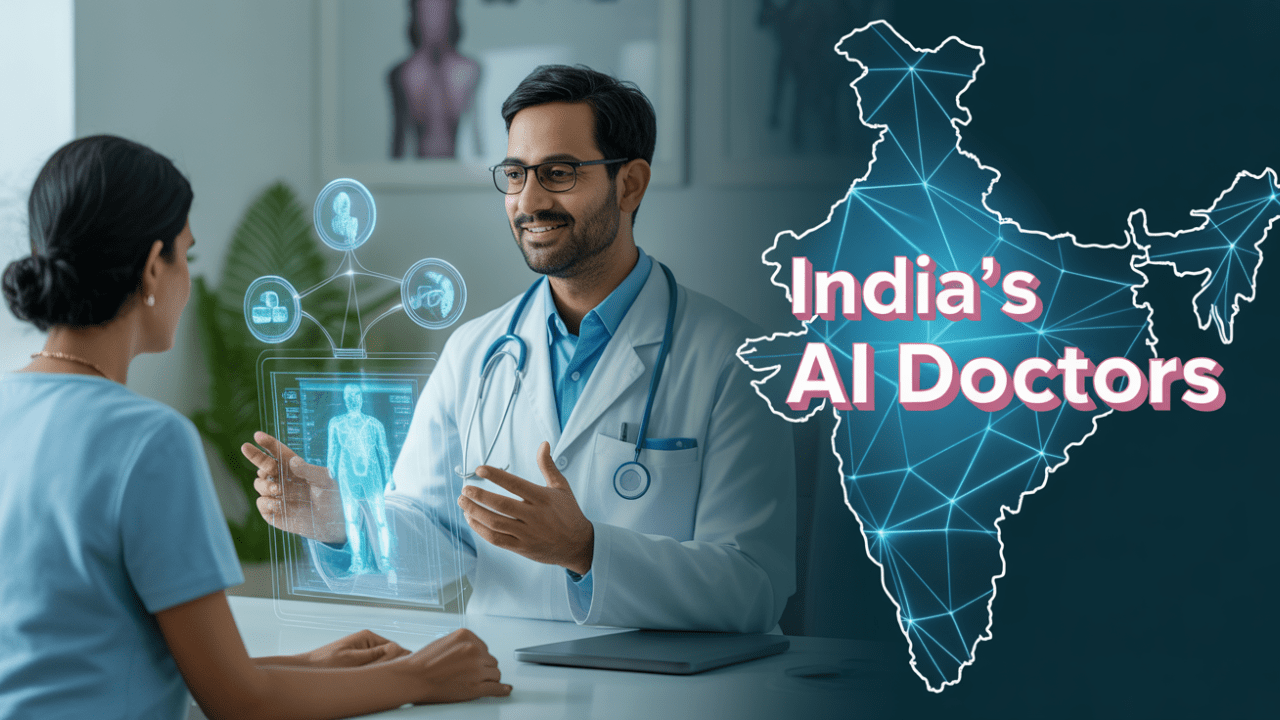
The Rise of Artificial Intelligence in Healthcare in India
The rise of Artificial Intelligence (AI) has impacted every sector and part of human life, including the healthcare sector globally and in India.
India, with its huge population and complexity in healthcare, has a technology that can make the healthcare system easy and accessible to the people.
In this article, we will explain the rise of AI in healthcare in India, its applications, benefits, challenges, and government initiatives.
Current Status of AI in Healthcare in India
The rising impact of AI can be seen in various parts of healthcare, ranging from diagnosis to treatment plans, patient management, medical billing, and administrative tasks.
According to a report, the healthcare AI market in India is expected to reach $1.6 billion by 2025, growing at a compounded annual growth rate (CAGR) of 40.6 percent.
This remarkable growth is supported by the increasing volume of healthcare data, advancements in machine learning, and the need for improved patient outcomes.
An area where AI in healthcare is rising
1. Disease Diagnosis and Imaging:
The use of AI in the radiology and pathology parts of healthcare is rising tremendously.
For example, many companies like SigTuple use AI to assist radiologists in diagnosing a few disease conditions like tuberculosis and diabetic retinopathy. According to a study, AI can improve diagnostic accuracy by over 15 percent.
2. Prevention of disease and AI:
As we know, AI works by using historical data that is fed to it. AI analyzes the millions of historical data points of different patients to predict the best possible health outcomes.
For instance, diseases that have almost similar signs and symptoms in different patients, such as diabetes or heart conditions, can easily be detected by using AI.
A study by Accenture estimates that AI applications can save the Indian healthcare system $10 billion per annum by 2025.
3. Telemedicine:
Online platforms like Practo and 1mg are using AI to streamline consultations with specialist doctors, making healthcare more accessible, especially in rural areas.
Here we can see the magic of AI, just imagine a vast country like India, where the majority of people live in rural areas, where health services are very bad. They can get a consultation with a specialist doctor sitting in a metro city without physically visiting, unless it is necessary.
These platforms are heavily dependent on AI to provide telemedicine services.
The government of India, under a national health mission, uses telemedicine with the help of AI to provide healthcare services in every corner of India through video recording.
4. Robotic Surgery:
Robotic surgery is a highly AI-intensive surgery. Here, AI enhances surgical precision.
For example, the Da Vinci Surgical System allows surgeons to use highly advanced AI-guided robotics instruments to perform minimally invasive surgeries.
5. Patient Management Systems: Hospital management is a complex system. It is very hard for a human to maintain everything.
AI is streamlining administrative and management systems in hospitals, such as scheduling, billing, and patient follow-ups.
AI-driven chatbots can provide 24/7 support to patients and patient parties. AI chatbots answer common queries and manage appointments, which ultimately reduces the burden on healthcare staff.
NITI Aayog’s AI Strategy: In 2018, NITI Aayog released a discussion paper outlining a national strategy for AI, emphasizing its application in sectors like healthcare.
The strategy aims to use AI to address healthcare challenges, including prevention of disease, diagnosis of disease, and patient care and follow-up.
Why AI is rising in India
1. Improved Accuracy:
AI algorithms can analyze large amounts of data very quickly and accurately. By analyzing the data, AI can provide us with a more accurate diagnosis and treatment plan.
2. Cost-Effectiveness:
As we know, the healthcare system is very expensive to maintain. Many jobs are repetitive. By implementing AI in such places, management can reduce operational costs and improve efficiency. These will ultimately lead to lower healthcare expenses.
3. Enhanced Patient Experience:
AI has tools that can provide personalized healthcare services and patient-specific treatment. Such types of services give a good experience to the patient and their family members.
4. Accessibility:
Access to healthcare services in a country like India is very difficult in rural and tribal areas. By using AI tools we can provide health services in those areas easily.
Focus on Personalization: AI in healthcare focuses more on accuracy, speed, and personalized treatment. This person’s specific services make things more special for an individual.
Conclusion
Artificial Intelligence is redefining healthcare in India, offering solutions to patients, hospitals, healthcare providers, and the government, making healthcare services accessible for all. Like every new thing, it has some challenges, but with the proactive action taken by the government, all these challenges can be tackled. The ultimate goal should be to provide healthcare solutions in India.