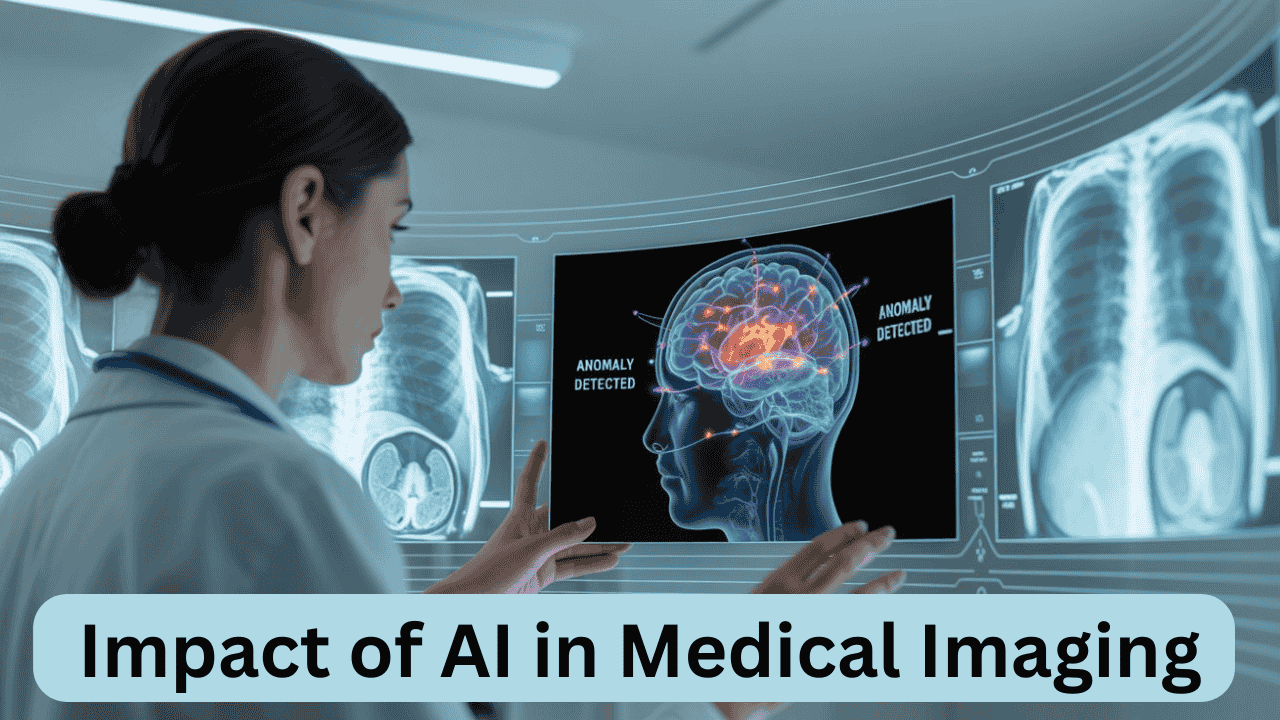
AI in medical imaging enhances diagnostic accuracy and reduces processing time, making it more efficient and ultimately saving lives. In this article, I aim to provide an understanding of the role of AI in medical imaging, using examples, data, and future predictions.
Before deep diving into AI’s role in medical imaging, we have to understand its meaning and key benefits.
AI in Medical Imaging
In simple words, AI in medical imaging means using machine learning, deep learning, and neural networks to analyze medical images. By medical images, I mean X-rays, CT scans, ultrasonography, etc.
Please note that AI just automates the process and does not provide the final decision. AI helps the radiologist or the doctor to make more informed decisions more efficiently.
Key Benefits of AI in Medical Imaging
- Faster diagnosis process
- Improved diagnostic accuracy
- Reduced human error.
- Cost-effective patient care.
How AI Works in Medical Imaging
In this portion, I will try to give you a rough idea of how AI works in medical imaging.
Collection of data: To make AI work, it needs to be trained with data. In this step, AI requires vast amounts of data. These include images from CT scans, MRIs, X-rays, and ultrasounds.
Algorithms and Training: In this stage, AI models are trained on hundreds and thousands of images of these X-rays and MRIs to identify patterns.
For example, to differentiate between benign and malignant tumors, a neural network uses labeled images.
Interpretation and Output: After following the above methods, AI algorithms can analyze new images of X-rays, ultras, etc, to provide diagnostic insight.
Examples of AI in Medical Imaging
It’s time for some examples so that you can understand this concept easily.
Breast Cancer Detection:
Example: We are all aware that Google Health developed an AI model that demonstrated a 9.4% reduction in false negatives for breast cancer detection compared to human radiologists.
Lung Disease and COVID-19 Detection:
Example: Alibaba’s AI system was used in China during the COVID-19 outbreak to analyze CT scans, achieving 96% accuracy in detecting COVID-19.
Cardiovascular Disease:
Example: a company named Arterys focused on medical imaging AI, To detect cardiovascular disease, they developed a system where markers are used on MRIs.
Neurological Disorders:
Example: An AI system can analyze PET (positron emission tomography)scans and MRI images to detect Alzheimer’s disease years before symptoms appear.
Statistics and Data on AI in Medical Imaging
Growth of AI in Healthcare:
The AI healthcare market size is expected to grow from $6.9 billion in 2021 to $67.4 billion by 2027, according to MarketsandMarkets
AI in Radiology:
AI can detect breast cancer at an accuracy rate of 94.5% whereas human radiologists can get an accuracy of 88%. As per the study of the Radiology Society of North America
AI in Medical Imaging for Different Departments
Radiology: AI has increased the accuracy of disease identification, such as cancer, fracture, etc, by analyzing and interpreting radiology images.
Pathology: In pathology, AI helps analyze blood samples and tissue samples in a quick manner with high accuracy in comparison to traditional methods.
Ophthalmology: For the diagnosis of diabetic retinopathy and other eye conditions, it traditionally happens in the last stage of the disease, as these condition shows symptoms at a later stage. But with the help of AI with its machine learning capacity, diagnosis can be done in such cases at an early stage.
Benefits of AI in Medical Imaging
AI has many benefits that can help improve the healthcare system in the world. A few of them are,
Accurate Diagnosis plays an important part in treatment, cost, and prognosis. AI improved the diagnosis accuracy and reduced false positive cases.
AI is an automated system that ultimately reduces the burden on healthcare workers. Now they can use their time to solve more complex cases.
As we have mentioned, AI can detect or diagnose a disease condition early, which ultimately reduces the extra cost that might have to be borne by the patient if the diagnosis is late.
AI in Medical Imaging Difficulties
Data Privacy and Security are one of the main challenges faced by AI in medical imaging. All the data will be saved in a cloud-based AI system, which is at high risk of data privacy breaches.
Standardization is one of the main difficulties because different healthcare systems will follow different formats of setup, which will be challenging for an AI system to integrate seamlessly across different institutions.
Last but not least is the ethical side of it. The main concern is whether AI will be able to replace human judgment in disease diagnosis.
AI in Medical Imaging Future Predictions
AI in healthcare is in the early stages. It has a long way to go. Here, we will try to understand the Future Predictions of AI in medical imaging.
AI Integration in Radiology will increase
AI will become the most common tool in the radiology department in the coming years. The reason is very simple: AI reduces time and increases the accuracy of diagnosis.
Personalized Medicine:
Every individual requires a different set of treatment and management, even if they suffer from the same condition, as they differ genetically. Here, AI is of great use for personalized medicine by analyzing the data.
AI for the prediction of disease:
Predictions or future outcomes of any health condition can be detected by using AI. AI analyzes millions of data points. By doing this, AI can easily identify any abnormal patterns for future prediction.
Making Healthcare Accessible:
This is the most interesting feature that I like the most. In rural areas, healthcare services are very poor. But with the help of AI, this issue can be solved.
Real-Life Case Study: AI in Lung Cancer Screening
AI has shown great signs in screening for early-stage lung cancer. Lung cancer is one of the most common and deadly health conditions.
A study published in Nature reported that Google’s AI model reduced false positives by 11% and false negatives by 5% in lung cancer screening compared to human radiologists.
By using this, we can detect many such cases in their early stage and ultimately improve the survival chances of these people.
AI impact on medical imaging is very vast and visible. At present, many diagnostic centres are using Artificial Intelligence for diagnosis. It is playing a vital and major role in the final diagnosis. Many complex cases are made easy by the use of AI. The impact will increase day by day in the future.
So, AI will play a major role in the medical sector for the diagnosis of many complex cases in less time.
nifpqxgwpvqxihyhuwopniqrlpdpuq
сервисный центр hp таганская сервисный центр hp спартаковская
ornwrvgyjgwqpqndwvgiwuhqitnhdq
ремонт принтеров hp москва ювао https://servis-hp-moskva.ru/
thc softgels for sleep provide gentle nighttime relief